
Policies affect millions of people.
Test them before you roll them out.

Policies affect millions of people. Test them before you roll them out.

Prior Foundry helps policy teams research evidence, simulate impacts on realistic populations, and draft decision-ready documents - with full transparency and auditability.

Prior Foundry helps policy teams research evidence, simulate impacts on realistic populations, and draft decision-ready documents - with full transparency and auditability.

From evidence to action in three steps

From evidence to action in three steps

Step 01

Research

Synthesize what works from the academic literature and comparable programs. Turn a problem into a structured set of policy options with traceable sources and clearly surfaced uncertainties.

Step 2

Simulate

Run impact simulations on synthetic populations built from large-scale survey data. See how different groups respond to each policy option across regions, demographics, and income levels.

Step 3

Act

Generate decision-ready deliverables - memos, policy notes, charts, and reports - grounded in evidence and simulation results. Validate outputs with targeted stakeholder feedback before rollout.

Grounded in real data, not guesswork

Grounded in real data, not guesswork

Grounded in real data, not guesswork

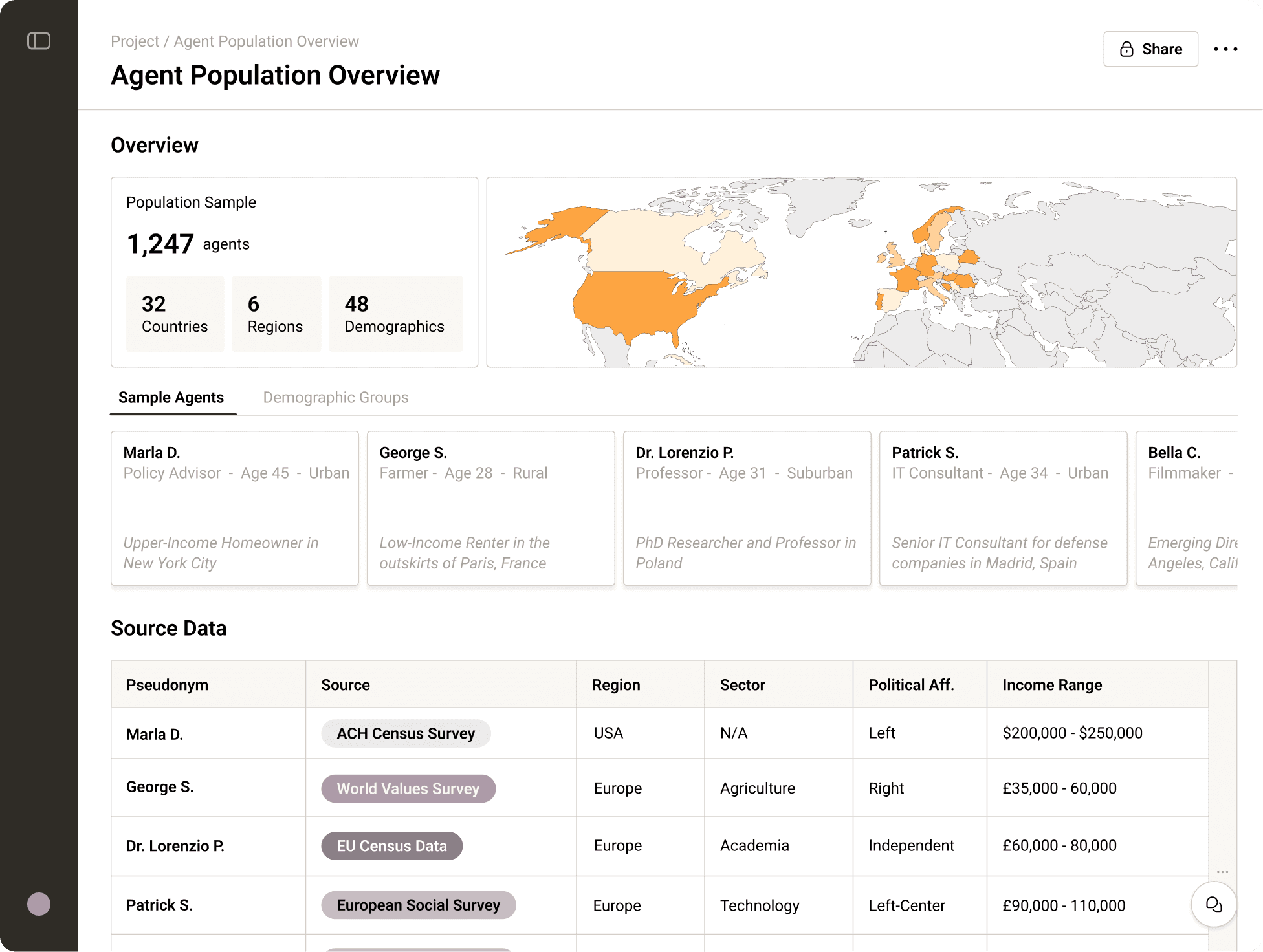
Our simulations use agent-based modeling built on large-scale probability surveys. Each synthetic population is composed of realistic profiles - individuals across sectors, roles, and demographic backgrounds - grounded in established academic research.

Our simulations use agent-based modeling built on large-scale probability surveys. Each synthetic population is composed of realistic profiles - individuals across sectors, roles, and demographic backgrounds - grounded in established academic research.

Our simulations use agent-based modeling built on large-scale probability surveys. Each synthetic population is composed of realistic profiles - individuals across sectors, roles, and demographic backgrounds - grounded in established academic research.

Real survey data

Agent profiles are built from the General Social Survey, World Values Survey, European Social Survey, and other high-quality probability surveys for representative modeling.

For organization-specific use cases, we can integrate a customer’s own survey data to build more tailored agent profiles and scenario analysis.

Peer-reviewed methods

Our simulation approach draws on published research in computational behavioral science, with robustness testing, permutation tests, and sensitivity analysis built in.


Survey-Based Generative Agents Generalize More Effectively Across Cultural Contexts than Demographic Agents

Large language models (LLMs) are increasingly used to simulate human populations and predict public opinion, yet there are concerns about their performance in cultural contexts outside the United States. Current practice relies on demographic agents, which are prompted with only basic demographic characteristics such as age, gender, and education. We introduce survey-anchored agents, a new approach that conditions LLMs on representative survey responses rather than demographics alone. Using the World Values Survey, which covers more than 50 societies worldwide, we compare the performance of survey-anchored agents against demographic agents across a wide range of political and cultural outcomes. Our results show that survey-anchored agents systematically achieve higher predictive accuracy, with the largest gains observed outside the United States where demographic cues are less informative. By grounding simulations in survey data, these agents capture cross-national variation in values and beliefs more effectively, narrowing the gap between model predictions and real-world human responses. This work provides a scalable framework for building culturally robust generative agents, and suggests that anchoring artificial populations in representative surveys can help ensure that LLM-based research and applications generalize across diverse social contexts.

Survey-Based Generative Agents Generalize More Effectively Across Cultural Contexts than Demographic Agents

Large language models (LLMs) are increasingly used to simulate human populations and predict public opinion, yet there are concerns about their performance in cultural contexts outside the United States. Current practice relies on demographic agents, which are prompted with only basic demographic characteristics such as age, gender, and education. We introduce survey-anchored agents, a new approach that conditions LLMs on representative survey responses rather than demographics alone. Using the World Values Survey, which covers more than 50 societies worldwide, we compare the performance of survey-anchored agents against demographic agents across a wide range of political and cultural outcomes. Our results show that survey-anchored agents systematically achieve higher predictive accuracy, with the largest gains observed outside the United States where demographic cues are less informative. By grounding simulations in survey data, these agents capture cross-national variation in values and beliefs more effectively, narrowing the gap between model predictions and real-world human responses. This work provides a scalable framework for building culturally robust generative agents, and suggests that anchoring artificial populations in representative surveys can help ensure that LLM-based research and applications generalize across diverse social contexts.

Designed for sensitive policy contexts

Policy work demands rigour, transparency, and control. Every part of Prior Foundry is designed with that in mind.

Human oversight

We support your judgment, not replace it. Assumptions are explicit and editable. You control every step of the process.

Full auditability

Every evidence source is traceable. Every simulation assumption is visible. Clear audit trails for every decision step.

Data sovereignty

Your data stays yours. We never train on it. Deploy into private, on-premise environments or existing secure cloud infrastructure.

Equitable modeling

Populations are modeled from representative probability surveys to reduce cultural and demographic bias. Distributional impacts are always surfaced.

Who we are

We combine academic leadership in computational behavioral science with real-world policy evaluation and large-scale engineering experience.

Dr. Jonne Kamphorst

Co-founder

Assistant Professor, Sciences Po Paris. Previously postdoctoral scholar at Stanford Human-Centered Artificial Intelligence Lab. Research on LLMs for simulating human behavior. Published in PNAS, American Political Science Review, and the Journal of Politics.

Shirin Abrishami Kashani

Co-founder

PhD candidate in Political Science at Stanford University. Former policy analyst at the OECD. Bridges the gap between research methodology and operational policy needs in public administrations.
Keshav Sivakumar

Co-founder

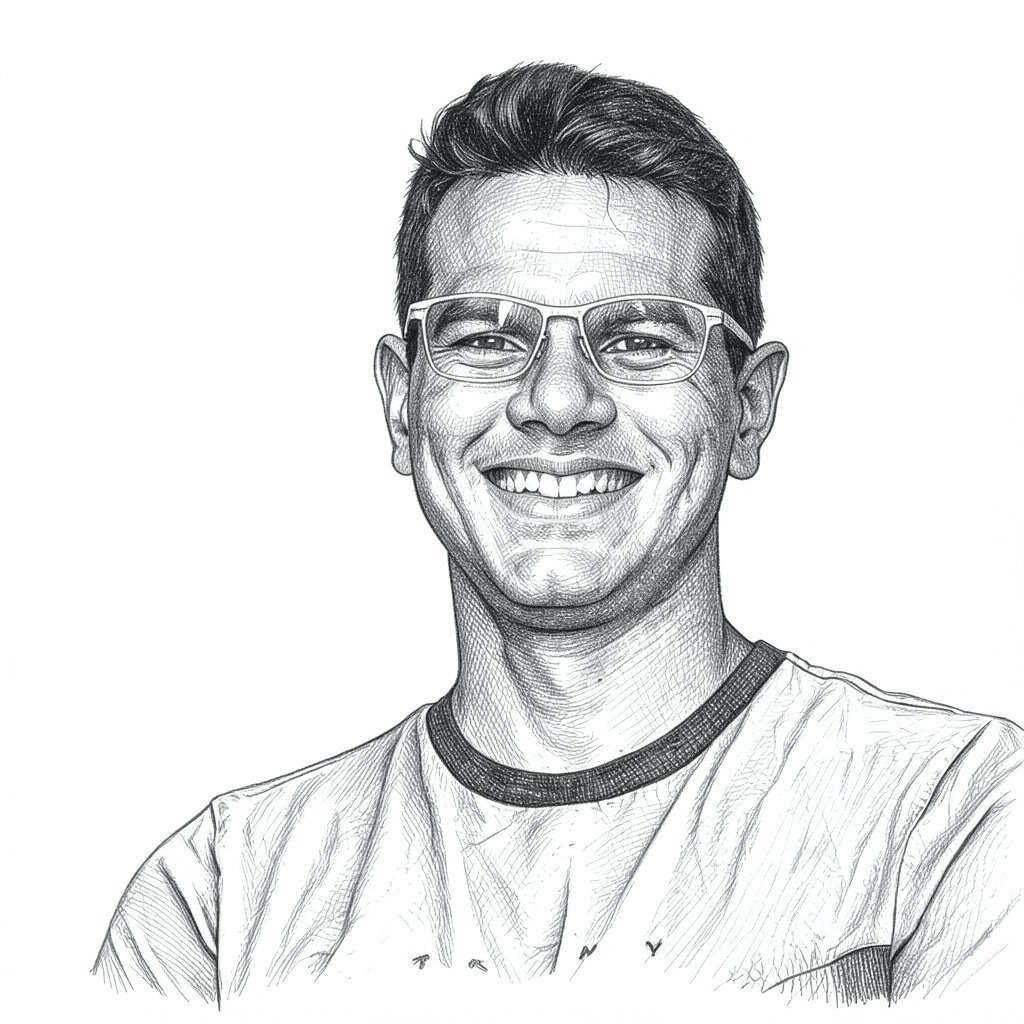
Computer Scientist trained at Cambridge & Stanford with experience building large-scale systems in industry. Responsible for the platform architecture and simulation infrastructure.

Partner with us

We design around real customer needs and maintain significant flexibility to tailor functionality to different operational contexts and requirements.

Prior Foundry helps policy teams research evidence, simulate impacts on realistic populations, and draft decision-ready documents - with full transparency and auditability.

2026 Prior Foundry. All Rights Reserved

Privacy Policy

Prior Foundry helps policy teams research evidence, simulate impacts on realistic populations, and draft decision-ready documents - with full transparency and auditability.

2026 Prior Foundry. All Rights Reserved

Privacy Policy

Prior Foundry helps policy teams research evidence, simulate impacts on realistic populations, and draft decision-ready documents - with full transparency and auditability.

2026 Prior Foundry. All Rights Reserved

Privacy Policy